
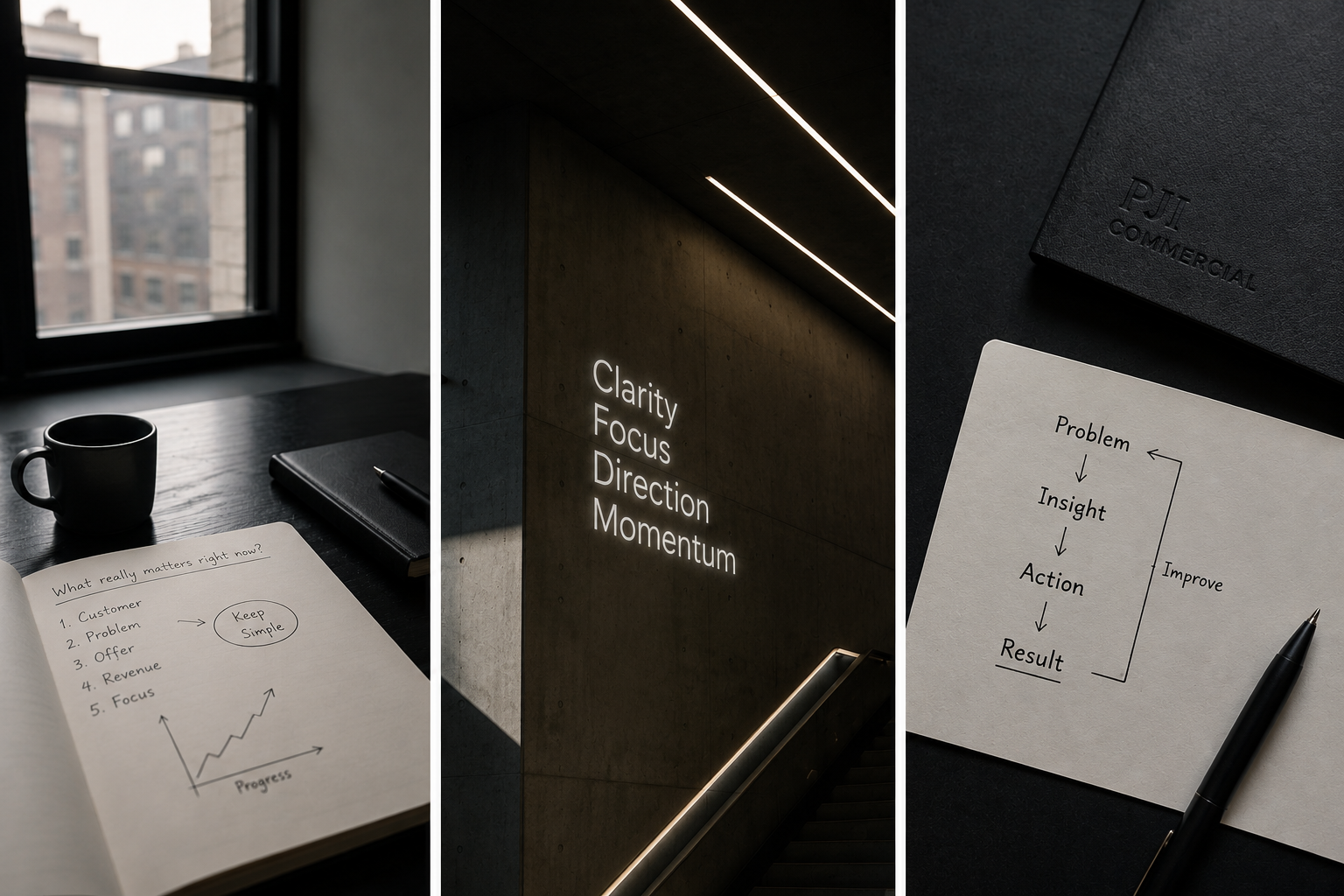
Why early-stage founders need practical commercial support
Published 10/04/2026
Early-stage founders are usually not short of ideas.
They are short of focus.
That is the bit people do not always talk about. The early stage of a business can feel exciting, but it can also become messy very quickly. There are product decisions, sales decisions, pricing decisions, brand decisions, team decisions and cash decisions all happening at the same time.
Most founders are trying to build the plane while flying it.
That is normal. But it is also where problems start.
A founder can have a strong product, a clear ambition and a genuine market opportunity, but still lose momentum because the commercial foundations are not clear enough. It is not always about working harder. Often, it is about knowing what to focus on first.
The early stage is where clarity matters most

In the early stage, every decision feels important.
The danger is that a founder tries to move everything forward at once. The website, the product, the sales deck, the pricing model, the CRM, the recruitment plan, the finance forecast, the investor conversations and the customer pipeline all start competing for attention.
That creates noise.
And when there is too much noise, decision-making gets weaker.
Practical commercial support helps founders cut through that. Not by adding more theory, more frameworks or more corporate language, but by helping answer simple questions:
What are we selling?
Who are we selling it to?
Why will they buy it?
How do we reach them?
How do we turn interest into revenue?
What needs to happen next?
These questions sound basic. But many businesses move too far without answering them properly.
Founders need someone who can challenge the thinking
Early-stage founders are often surrounded by encouragement. That has value, but it is not always enough.
A founder also needs someone who is willing to ask harder questions.
Is the offer clear enough?
Is the pricing realistic?
Is the target customer too broad?
Is the sales process too vague?
Is the business relying too much on hope and not enough on structure?
These are not negative questions. They are useful questions.
The earlier they are asked, the easier it is to correct the direction.
A founder does not need a consultant who turns everything into a 60-page strategy document. They need someone who can look at the business from the outside, understand the commercial reality and help them make better decisions quickly.
Commercial strategy should not be complicated
There is a lot of language around business growth that makes things sound more complicated than they need to be.
For most early-stage businesses, the first commercial strategy should be straightforward.
It should define the offer, the audience, the route to market, the sales approach, the numbers that matter and the next actions.
That does not mean it should be shallow. It means it should be useful.
A good commercial plan should help the founder know what to do this week, this month and this quarter. It should help them avoid distraction. It should make the business easier to explain to customers, partners, funders and future team members.
If a plan cannot be used in the real world, it is not a plan. It is a document.
The biggest risk is drifting
One of the biggest risks for early-stage founders is drift.
Drift happens when the business keeps moving, but not necessarily in the right direction. Meetings happen. Content is created. Conversations are had. New ideas appear. The founder stays busy.
But the business does not get materially closer to stronger revenue, clearer positioning or a more repeatable model.
That is expensive.
Not always in obvious ways, but in time, energy, confidence and missed opportunity.
This is why early-stage support is valuable. It helps founders stop guessing and start making clearer commercial decisions.
Where I can help
My background is in building and growing businesses, particularly where the route to market, revenue generation and commercial structure matter.
I am not here to tell founders how to build something I have never done myself. My value is in helping founders think clearly about the commercial side of the business and shape a more practical route forward.
That could mean refining the offer, reviewing the sales process, improving the go-to-market approach, building a more focused growth plan or helping the founder prepare for the next stage.
The work is not about making the business look more complicated.
It is about making the business sharper, clearer and more commercially focused.
Final thought
Early-stage founders do not need more noise.
They need clarity, challenge and practical direction.
The earlier that support comes in, the more useful it can be. Because at the early stage, small decisions can have a big impact on what the business becomes.
Related: