
AI adoption in business: start with the problem, not the technology
Published 24/04/2026
AI is everywhere at the moment.
That creates opportunity, but it also creates confusion.
A lot of business owners know they should be looking at AI. They can see that it is moving quickly. They can see competitors talking about it. They can see tools appearing in almost every part of the business.
But knowing AI matters is not the same as knowing what to do with it.
That is where many businesses get stuck.
They either do nothing because it feels too technical, or they jump into tools without a clear reason. Neither approach is ideal.
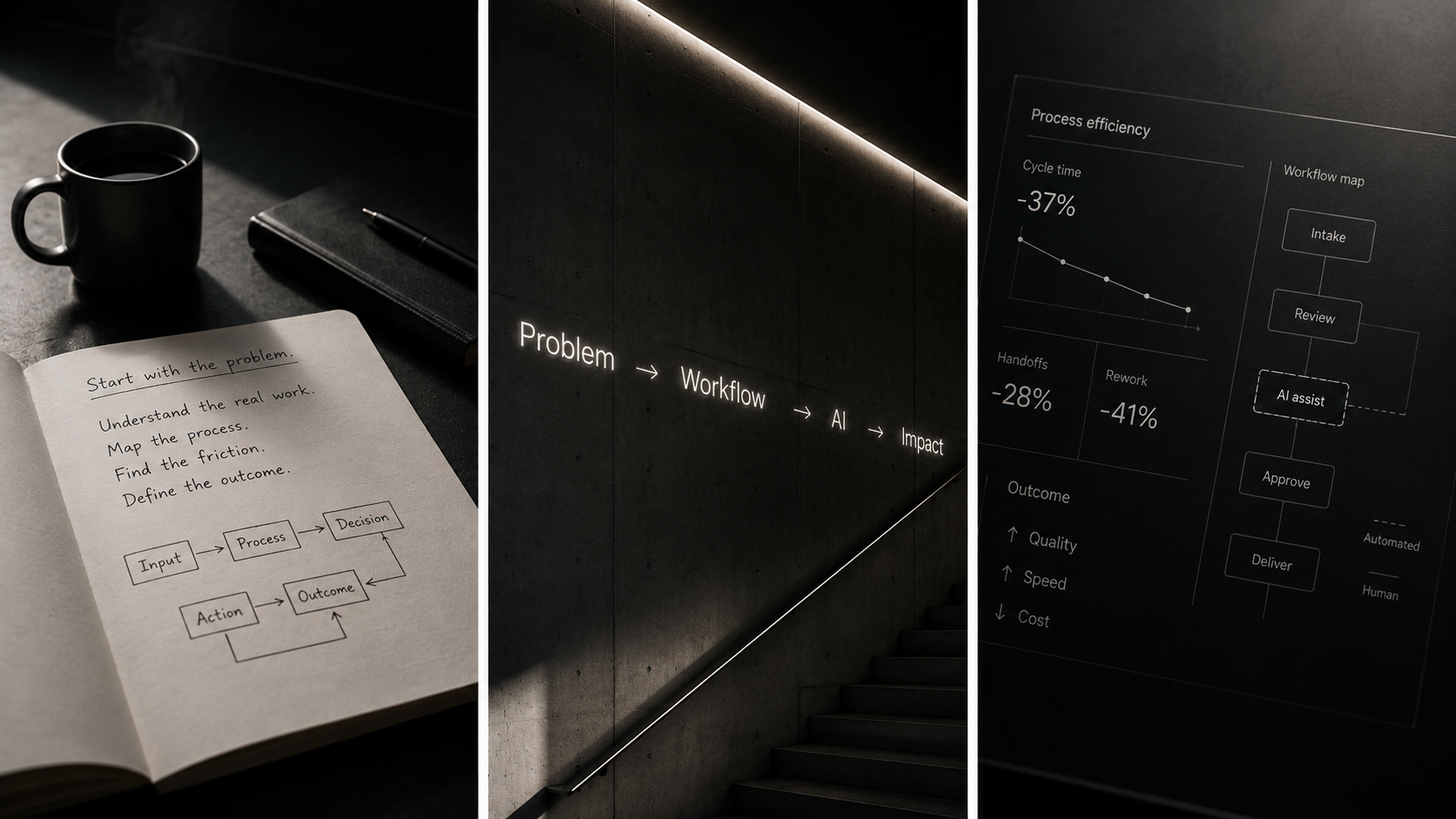
The better starting point is simple: do not start with the technology. Start with the business problem.
AI is not a strategy on its own
AI should not be treated as a magic fix.
It is a tool. A powerful one, but still a tool.
The value comes from applying it to the right problems in the right way. That could be improving sales admin, speeding up research, helping with customer support, creating better reporting, improving content workflows, summarising information or helping teams work through repetitive tasks faster.
But if the business does not know what problem it is trying to solve, AI can quickly become a distraction.
The question should not be, "How do we use AI?"
A better question is, "Where is the business wasting time, missing information or making slower decisions than it needs to?"
That is where AI might help.
Look for friction inside the business

Most businesses have friction.
It shows up in small ways.
Sales teams spend too long preparing proposals.
Customer information sits in different places.
Reports take too long to produce.
People repeat the same admin tasks every week.
Good ideas get lost because nobody has time to shape them properly.
Leaders make decisions without enough insight because the information is scattered.
These are practical problems. They are also the kind of problems where AI can often be useful.
Not because AI replaces the judgement of the team, but because it can reduce manual effort, organise information and help people get to a better starting point faster.
Keep adoption simple at first
A common mistake is trying to make AI adoption too big too soon.
For most businesses, the first step should not be a huge transformation project. It should be a focused review of where AI can make a practical difference.
Start with one department, one workflow or one problem.
Find something that is repetitive, time-consuming or information-heavy.
Then test whether AI can improve it.
That could mean building a simple process for using AI in sales preparation. It could mean using AI to summarise customer feedback. It could mean helping a leadership team turn notes and ideas into clearer actions. It could mean improving the way reports are created and reviewed.
The point is not to look clever.
The point is to improve how the business works.
People need confidence, not just tools

AI adoption is not only about software.
It is about people.
Teams need to understand where AI can help, where it cannot help and how to use it responsibly. If people are unsure, they either avoid it or use it badly.
That is why leadership matters.
Business owners and senior teams need to set the direction. They need to explain why AI is being used, what it is intended to improve and what standards the business expects.
AI should not be introduced as a threat. It should be introduced as a way to remove friction, improve quality and give people more time to focus on higher-value work.
But that only happens if adoption is handled properly.
The businesses that act now will learn faster
There is a risk in waiting too long.
AI will keep improving. The tools will change. The market will move. But businesses that start learning now will build confidence earlier.
That does not mean chasing every new tool.
It means developing a practical understanding of where AI fits inside the business.
The companies that benefit most will not be the ones shouting the loudest about AI. They will be the ones quietly using it to improve real processes, reduce waste and make better decisions.
Where I can help
My interest in AI is practical.
I am interested in how it can help businesses work better, sell smarter, reduce wasted time and improve commercial performance.
For many businesses, the first step is not building a complicated AI system. It is identifying the areas where AI could make the biggest difference and creating a sensible adoption plan.
That means looking at the business, understanding how the team works, finding the friction points and shaping a realistic way forward.
AI adoption should be useful, not theatrical.
Final thought
AI is not something businesses can ignore.
But it should not be adopted blindly either.
The right approach is to start with the business problem, keep the first use cases simple and build confidence through practical wins.
That is how AI becomes useful.
Not as a buzzword, but as a real tool for improving the business.